The Nobel Prize Winner Team Developed a Simple New Coronavirus Detection via Mobile Phone
According to statistics from the World Health Organization (WHO), in the three days from October 8th to October 10th, the number of newly diagnosed COVID-19 patients worldwide increased by 1 million. With the arrival of autumn and winter in the northern hemisphere, the control of the COVID-19 epidemic still faces severe challenges. Fast and accurate nucleic acid testing can help medical workers find patients infected with the new coronavirus earlier, so that they can be treated/isolated and contact tracing. Most of the current nucleic acid tests still require samples to be sent to specialized laboratories for processing, and it often takes a day or even longer to obtain results, which may delay the time for patient treatment and isolation.
Therefore, researchers are unanimously striving to develop faster and easier nucleic acid detection. Using CRISPR technology to speed up detection is one of the directions. The WuXi AppTec content team also reported previously on the efforts of the team led by the famous scholar Dr. Feng Zhang and his collaborators to develop simple new coronavirus detection using CRISPR technology. In order to make the detection more rapid and simple, the STOPCovid detection of Zhang Feng's team has undergone continuous iterations. It not only uses constant temperature PCR instead of traditional PCR, but also deletes the process of purifying RNA, and optimizes the steps to improve the sensitivity of detection.
A few days ago, a team led by Dr. Jennifer Doudna, one of the winners of this year's Nobel Prize in Chemistry, and her partners published a paper on the preprint website medRxiv, which developed a new type of new coronavirus detection based on CRISPR-Cas13a technology. The difference of this test is that it does not require RT-PCR to amplify viral RNA, and can directly quantify the level of viral RNA in the sample. The researchers also developed based on a smart phone detection system of the camera, so that the medical staff does not require complicated instrument, you can read the test results outside the lab environment. Without PCR, improve the sensitivity of CRISPR detection.
The core principle of this test is not difficult to understand. The researchers used an enzyme called Cas13a and CRISPR RNA (crRNA) combined with it to form a complex. When crRNA is combined with the specific sequence on viral RNA, it can activate Cas13a enzyme. Cas13a is an interesting enzyme. Once activated, it will indiscriminately cut through any other single-stranded RNA molecules encountered around it. Using this feature, researchers will also add a fluorescent molecule connected by RNA to the sample. Once Cas13a is activated, the RNA on this special molecule will be cut off, releasing fluorescent molecules that emit fluorescence. In this way, by reading the fluorescent signal, the presence of virus-specific sequences can be detected. In order to improve the sensitivity of the previous CRISPR detection based on this principle, the RNA in the sample was amplified by PCR. However, this PCR step not only increases the time required for detection, but also means that the number of detections will be limited by the supply of PCR reagents.
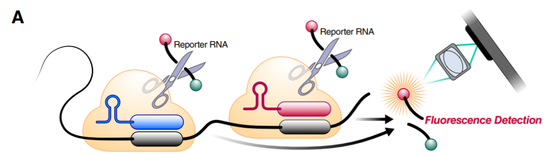
Using multiple crRNAs targeting different viral sequences can improve detection sensitivity
In this study, the researchers used another method to improve the sensitivity of detection. They speculated that since a crRNA that binds to a virus-specific sequence can activate the Cas13a enzyme activity, whether two crRNAs that bind to a different virus-specific sequence can activate the Cas13a enzyme activity faster and increase the rate of fluorescence signal Become faster? The experiment also confirmed their hypothesis. When the researchers used two different crRNAs to activate the Cas13a enzyme, although the total crRNA levels did not change, the growth rate of the fluorescent signal was significantly increased. By detecting the growth rate of the fluorescent signal instead of the absolute value of the fluorescent signal, they found that using two crRNAs can significantly improve the sensitivity of detection. When one crRNA is used, the detection sensitivity reaches 10,000 copies/μl, and when two different crRNAs are used, the sensitivity increases to less than 1000 copies/μl.
In order to further improve the sensitivity of the detection, the researchers developed a detection method that contains three crRNAs targeting different specific RNA sequences of the new coronavirus. In the experiment of detecting nasopharyngeal swab samples from 5 COVID-19 patients, this detection was accurate These 5 positive samples were found, and the rate of increase of the fluorescence signal has a very good linear relationship with the number of virus copies in the input sample, which further proves that this test can be used to quantitatively measure the virus level.
Build a simple signal reading system using smartphone cameras
In order to prove that this simple detection can be used in an environment outside the laboratory, the researchers built a simple fluorescence signal detection system based on a smartphone camera. To their surprise, the sensitivity of this fluorescence signal detection system based on mobile phone cameras was an order of magnitude higher than that of commercial plate readers used in the laboratory. Using this simple fluorescent signal detection system, researchers can determine that the nasopharyngeal swab samples of 5 COVID-19 patients are positive in just 5 minutes.

Fluorescence signal reading system based on smart phone camera design
The researchers pointed out in the discussion section that not only are smartphones very popular today, but their cameras are highly sensitive. More importantly, smartphones usually carry GPS and can connect to the Internet. This makes it easier to transfer the read results to the cloud database to assist in contact tracking. The new coronavirus detection system based on smartphones may play an important role in controlling current and future pandemics.


Comments
Post a Comment
Please let me if you have any question