Wasp Venom Peptide Shows Potential as an Effective Antibiotic Candidate
According to foreign media New Atlas, as antibiotic-resistant bacteria will become a huge health problem in the coming decades, the world urgently needs new drugs and treatments. Now, researchers at the University of Pennsylvania have designed new antibacterial molecules from wasp venom, which has shown promise in tests on mice.

Antibiotics are one of the most important scientific breakthroughs of the 20th century, preventing many people from dying from infections. But unfortunately, decades of overuse have caused bacteria to increasingly develop resistance to drugs. It is predicted that without intervention, by 2050, these "super bacteria" may cause up to 10 million deaths each year. In order to prevent this nightmare scenario from happening, scientists are studying a whole set of new candidate antibiotics and are also looking for other non-drug methods to destroy them, including lights, materials, magnetic nanoparticles that shred them, and even molecules. A particularly promising new drug candidate pathway is the venom of various animals and insects, such as rattlesnakes, scorpions and wasps. The new research investigates the last one.
"New antibiotics are urgently needed to treat the increasing number of drug-resistant infections, and venom is an untapped source of new potential drugs," said César de la Fuente, senior author of the study. "We believe that venom-derived molecules like the one we designed in this study will become a valuable source of new antibiotics." In this case, the team started with a highly toxic peptide found in Korean wasp venom. This peptide is called mastoparan-L and can kill bacteria, but unfortunately, it is also harmful to humans-it destroys red blood cells and may cause anaphylactic shock in some people. So the team must find a way to transform it.
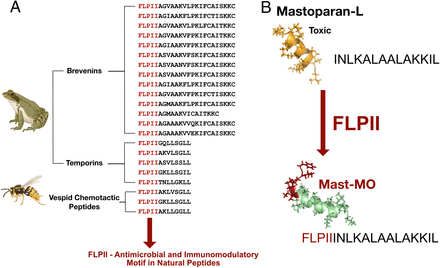
It is believed that a part of the peptide end is responsible for the toxicity to humans, so the researchers replaced this part with a pentapeptide group-a region known to have strong activity against bacteria in antimicrobial peptides. The end result is a new molecule, which the team calls mast-MO. Next, they tested the new molecule in mice infected with lethal levels of E. coli or Staphylococcus aureus. Mast-MO seems to protect the mice in most cases-80% of the treated animals survived, while those that received only the natural mast-L peptide were much less likely to survive. Mast-MO can also be administered safely at higher doses, while mast-L at the same level can cause serious side effects. The research team also found evidence about how the molecule fights bacteria. It seems to make their outer membranes more porous and make it easier for molecules to penetrate into their bodies, which may indicate that cooperating with other drugs can further improve antibacterial response. At the same time, mast-MO seems to be able to "call" more immune cells to the site. Studies have found that several variants of mast-MO have antibacterial activity, and the research team hopes to continue to develop them into drugs to help combat this emerging health threat.
The research was published in the journal Proceedings of the National Academy of Sciences .


Comments
Post a Comment
Please let me if you have any question